Why Psychological Safety Looks Different in Asia — And Why It Matters More Than Ever for C-Suite Leaders
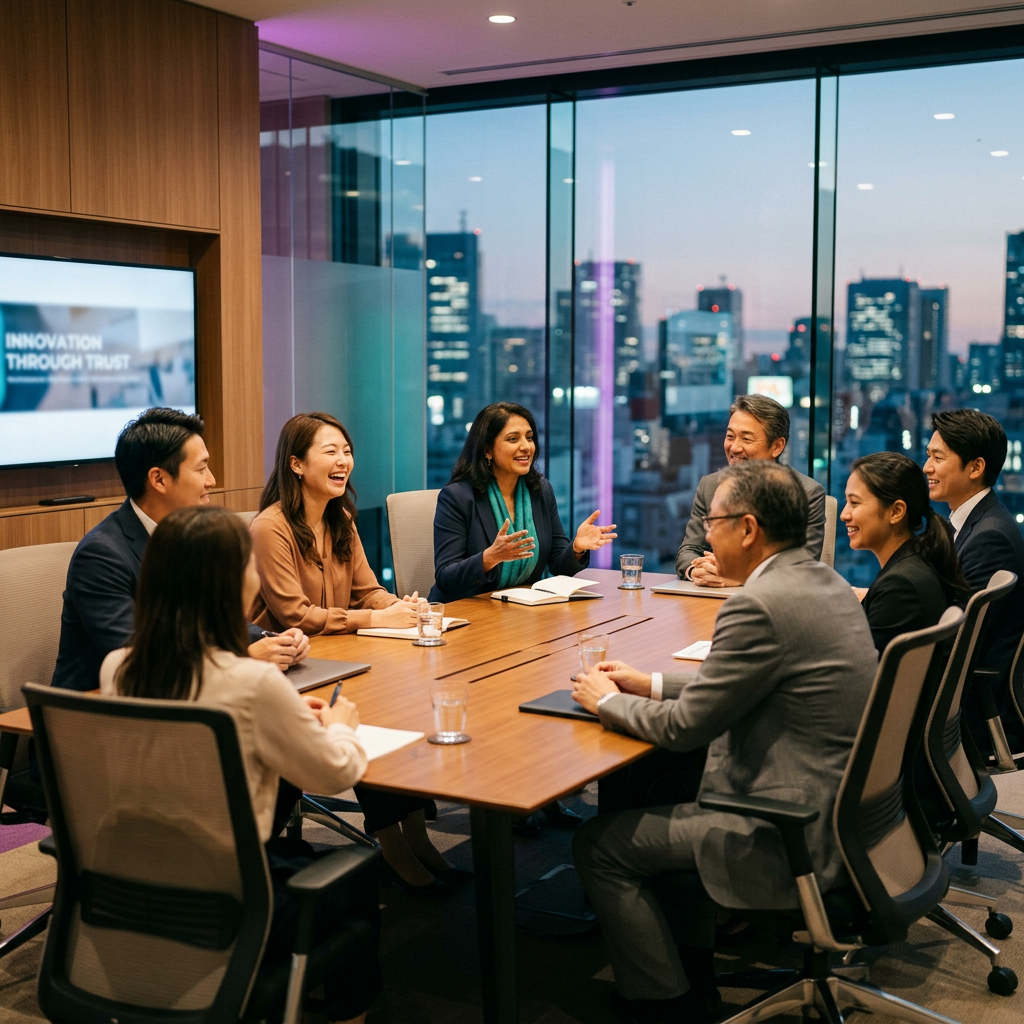
I've sat in both rooms.
The high-energy Western-style town hall where the CEO invites challenge and someone in the third row actually does — and is celebrated for it.
And the Asian boardroom where a critical concern about a major initiative was raised with me quietly, in the corridor, after the meeting. Never in it.
Same issue. Two completely different expressions of the same human need: to be heard without fear.
Having spent my career across global MNCs and local organisations — and watched how differently psychological safety plays out across both — I can tell you this: it's not about one being right and the other wrong. It's about understanding why they differ, and what that means for how you lead.
The organisation's life cycle matters too. A scrappy 50-person startup operates differently from a 10,000-person regional conglomerate — even within the same culture. But that's a piece for another day.
Today, I want to focus on the East-West divide — because it's where I see the most well-intentioned leaders get it wrong, and where getting it right unlocks something remarkable in your teams.
The Business Case No One Is Talking About
Google's Project Aristotle found it. Amy Edmondson proved it. McKinsey confirmed it: psychological safety is the single biggest predictor of high-performing teams.
And yet, in boardrooms across Asia, it remains one of the most misunderstood — and misapplied — leadership concepts of our time.
For C-suite leaders operating in Asian markets, the question isn't whether psychological safety matters. The data is unequivocal. The question is: how do you build it in a cultural context where the rules of hierarchy, face, and deference run deep?
The Western Model — And Why It Doesn't Fully Translate
In Western organisational culture, psychological safety is often operationalised as: speak up, challenge ideas, embrace conflict as healthy.
Town halls where employees question the CEO. Meetings where junior staff push back on senior leaders. Cultures where "radical candour" is celebrated.
This model assumes a relatively flat power distance — a culture where challenging authority is not just acceptable, but encouraged.
In much of Asia, that assumption breaks down.
Across Singapore, Malaysia, Japan, South Korea, and China, Hofstede's research consistently shows high power distance cultures — where hierarchy is respected, face is protected, and public disagreement carries real social risk.
This doesn't mean Asian employees don't have opinions. It means they express them differently — or not at all, when the cost feels too high.
The result? Silent meetings. Unspoken dissent. Innovation that never surfaces. And teams that appear aligned but aren't.
What Psychological Safety Actually Means in an Asian Context
Psychological safety in Asia isn't about dismantling hierarchy. It's about creating safe channels within it.
As an executive coach working across Asia, I've seen this play out repeatedly: the leader who creates safety doesn't eliminate deference — they create permission structures that work with the culture, not against it.
This means:
- 1:1 conversations before group decisions — giving people space to voice concerns privately before they're asked to speak publicly
- Leader vulnerability first — when the CEO or MD shares a mistake or a moment of uncertainty, it signals that imperfection is survivable
- Structured feedback mechanisms — anonymous surveys, small group reflections, or dedicated "challenge sessions" that normalise input without requiring public confrontation
- Separating the idea from the person — framing disagreement as collective problem-solving ("How might we strengthen this?") rather than personal challenge
The Business Impact: What's at Stake
For C-suite leaders, this isn't a "nice to have." Here's what the absence of psychological safety costs your organisation:
- Innovation stalls. When people don't feel safe to propose new ideas, your pipeline dries up — especially critical as AI reshapes every industry.
- Talent walks. High performers — particularly younger, globally-minded talent — leave cultures where they feel unseen or unheard.
- Risk goes unmanaged. The most dangerous business failures often have a trail of unspoken warnings. Psychological safety is your early warning system.
- Change initiatives fail. In my work in change management across Asia, the #1 reason transformations stall is not strategy — it's that people don't feel safe enough to genuinely engage with the change.
Research from Edmondson and others shows that teams with high psychological safety demonstrate 27% reduction in turnover, 76% more engagement, and significantly higher innovation output.
What C-Suite Leaders Can Do Monday Morning
- Model it from the top. Share one thing you got wrong recently in your next leadership communication. Watch what it unlocks.
- Audit your meeting culture. Who speaks? Who doesn't? Are the same voices dominating? Silence in Asian meetings is rarely agreement.
- Create private channels for honest input. Not just annual engagement surveys — regular, lightweight mechanisms for real feedback.
- Reward the question, not just the answer. Publicly recognise someone for raising a difficult issue. It signals to the whole organisation what's safe.
- Train your leaders, not just your teams. Psychological safety is built or broken at the manager level. C-suite commitment must cascade.
The Bottom Line
Psychological safety is not a Western concept inappropriately imported into Asian organisations. It is a universal human need — the need to contribute without fear — expressed differently across cultures.
The leaders who understand this nuance, and build safety in culturally intelligent ways, will be the ones who unlock the full potential of their teams in the future of work.
And in a world reshaped by AI and disruption, that capability isn't optional. It's your competitive advantage.
Adeline Tiah is an ICF PCC Certified Executive Coach based in Asia, with 28 years of corporate leadership experience across global MNCs. She specialises in leadership transformation, high-performing teams, and culture change — and is the author of Reinvent 4.0, a guide to leading with purpose in an age of disruption.
Keep exploring
Psychological Safety for Leaders & TeamsRelated reading
- The Best Performer You Almost Fired Was the Quiet One
"Confidence and competence are not the same thing. Here is why your best people are being overlooked." My boss once told me to fire my best performer. Her reason was simple. She is too quiet. That is affinity bias in action, and it is quietly costing organisations their best people.
- How to Talk to Your Team About AI Without Triggering Panic
Her sharpest team member leaned into AI harder than anyone. Then she walked in and asked: 'If the tools can do this much, what do you still need me for?' That question is in your organisation right now. You just haven't heard it yet.
- You Think Your Team Trusts You. Here's How to Find Out If They Actually Do.
The gap between a leader's perception of trust and their team's lived experience of it is one of the most consistent blind spots in organisational life. Here's how to find out where you actually stand.
Adeline Tiah
Leadership & Team Coach | ICF PCC | Author of Reinvent 4.0